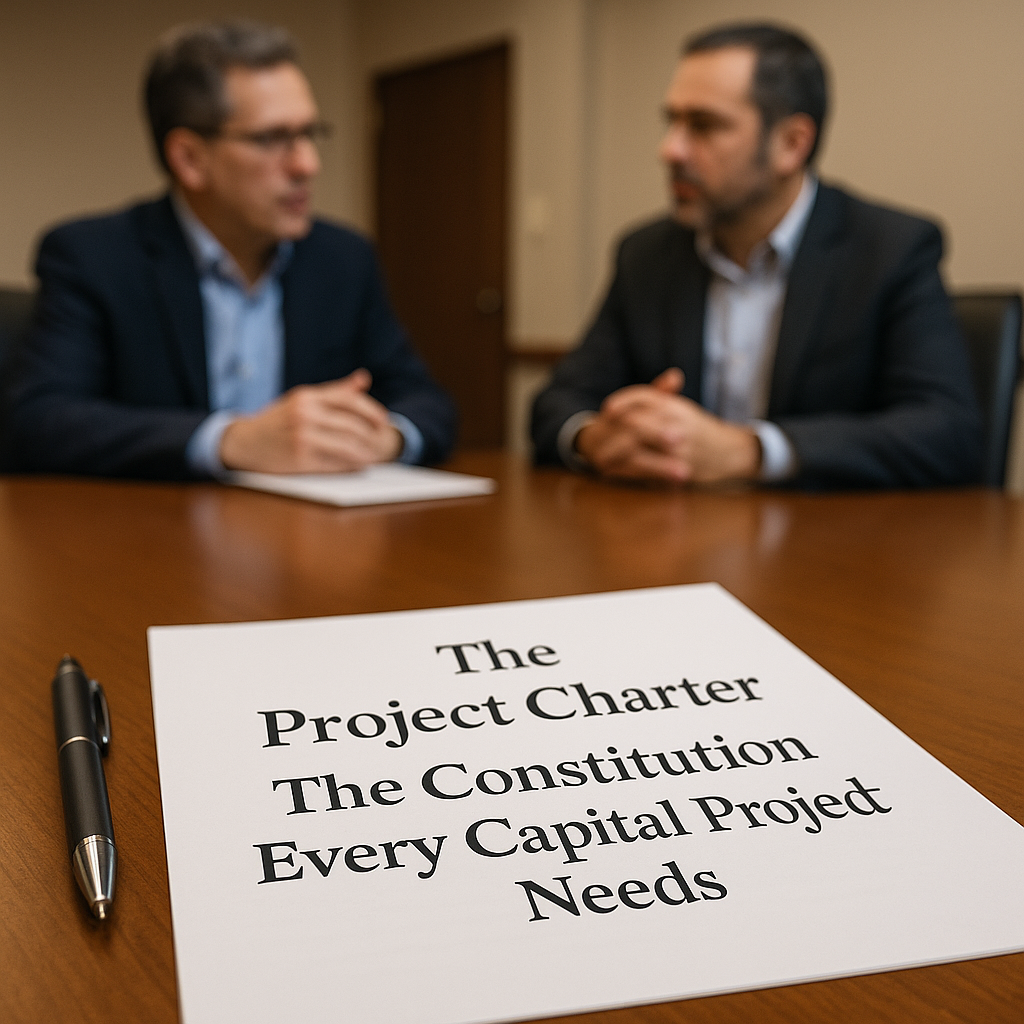
The Project Charter: The Constitution Every Capital Project Needs
Despite its simplicity, the charter is one of the most powerful alignment tools an owner can use. Done right, it becomes the guiding force that defines intent, shapes scope, clarifies governance, and protects the team from confusion, drift, and political infighting. Done poorly —or skipped entirely— it becomes a silent root cause of predictable failure.
This episode explores why the charter is so essential, what belongs in it, who should see it, how to build one, and what happens when teams rush or skip this step.
1. Why the Project Charter Is the “Constitution” of the Project
Most organizations underestimate the charter. They think of it as a formality, a short document no one reads. In reality, the charter serves the same purpose for a project that a constitution serves for a nation:
It defines why the project exists
It outlines what must be achieved
It establishes how decisions will be made
It anchors all future work to a shared direction
Just as the U.S. Constitution governs a massive body of federal law, the project charter governs all downstream engineering deliverables, business decisions, and project workstreams.
And like a constitution, it is short by design but powerful in function.
2. What Every Strong Project Charter Must Include
Cristian and Luis walk through the six essential components every charter must contain to be effective. If even one is missing, alignment suffers and risk increases dramatically.
1. Business Intent
The single most important section.
Why are we doing this project? What value are we pursuing?
Shockingly, Luis notes that junior engineers can work for years on a project and never be told the business purpose. That disconnect is a major root cause of misalignment.
2. Success Criteria
Not generic fluff like “on time and on budget.”
Real success criteria must clearly articulate what value looks like for this specific project.
Cristian shares an example from his engineering leadership days:
safe startup
on-spec product quickly
on-nameplate capacity
no unplanned events
If success is not defined intentionally, every function will invent its own version—and they won’t match.
3. Scope Boundaries
High-level clarity on:
what’s included
what’s excluded
what is still undecided
Documenting undecided items is just as important as it allows the team to focus effort and avoid silent assumptions.
4. Assumptions
Every project requires assumptions about permits, utilities, technology, tie-ins, market factors, and more.
Bad assumptions → bad decisions.
Explicit assumptions → testable decisions.
5. Governance & Decision Rights
One of the most neglected sections.
The charter must clarify:
who decides
who approves
who owns
Misalignment here leads to politics, turf battles, bottlenecks, and endless negotiation. Clear governance prevents early-stage chaos and late-stage dysfunction.
6. Leadership Expectations
The behaviors expected from sponsors and project leaders: e.g. clarity, transparency, accountability, and collaboration.
These six elements set the project’s foundation. Without them, organizations invite ambiguity, friction, and scope drift from day one.
3. Who Should See the Project Charter? (More Than You Think)
Too often, the charter (if it exists) is shared with only a handful of senior leaders. Cristian and Luis argue strongly against this.
The charter must be visible to:
sponsors
business leaders
engineering
operations
HS&E
finance
supply chain
project controls
owner’s engineering
construction partners (selectively)
engineering contractors (fully)
Why?
Because you cannot expect alignment around something the team has never seen.
Luis recommends using the charter as an onboarding tool, not just a document handed out, but a discussion facilitated by leadership to align everyone on intent, boundaries, and expectations.
4. Should Engineering Contractors See the Charter?
A resounding yes.
The engineering contractor is shaping the very decisions that determine the success of the project. They cannot be expected to make correct tradeoffs if they do not know:
the business intent
the success criteria
the scope boundaries
the assumptions
the governance model
But Cristian emphasizes one key distinction:
“Share the charter fully.
But do not delegate creating it.”
If owners don’t define their intent, contractors will fill the void using their defaults and those defaults may not align with the owner’s value drivers.
5. What About Construction Contractors?
Sharing is more nuanced, but still essential.
Construction partners need visibility into:
the purpose of the project
the high-level scope
schedule drivers
operability intent
site constraints
Because their decisions affect:
constructability
access
sequence
schedule realism
safety
Greenfield vs. brownfield? Turnaround tie-ins? Live-unit constraints? They need to know. Without that clarity, construction-driven decisions miss the mark.
6. How to Build a Strong Charter (The Right Way)
A charter is simple in appearance, but not simple to create well.
Cristian and Luis describe the correct approach:
Build the charter through a structured workshop.
Bring the right leaders
Facilitate healthy debate
Surface misalignment early
Challenge assumptions
Capture clarity
Iterate intentionally
Luis emphasizes the importance of a neutral facilitator, someone who can ask questions, tease out hidden assumptions, and keep the room from falling into political or positional debates.
This process requires deliberate effort and meaningful discussion. But the output is high-value clarity and alignment.
7. What Happens When You Rush or Skip the Charter?
The risks are not theoretical, they are predictable.
Skip the charter:
→ predictable failure
→ no basis for decision
→ no alignment
→ no definition of success
Rush the charter:
→ stakeholders invent their own success criteria
→ schedules become political
→ scope becomes a warzone
→ changes explode in FEL-3
→ rework, delays, and wasted money
→ leadership confusion
→ loss of team morale
→ infighting that poisons the project culture
Cristian describes scope battles as “throwing a wrench in the engine”, they escalate quickly and cripple progress.
Luis shares how weak charters cause massive changes late in FEL-3, forcing rework and derailing schedules.
Yes, sometimes macro events legitimately require charter changes.
But 95% of chaos comes not from external shocks but from poor charter discipline.
8. Final Thoughts: Clarity Is a Competitive Advantage
Luis closes the episode with a line that encapsulates the entire discussion:
“In capital projects, clarity is a competitive advantage.
And the charter is where clarity begins.”
The project charter is not paperwork.
It is not a corporate formality.
It is not a box to check.
It is the single most important alignment tool at the beginning of the project.
Get it right and the rest of FEL flows with purpose.
Get it wrong —or skip it— and the project inherits misalignment, confusion, conflict, and failure.
Loved this episode?
Be sure to subscribe, rate the show, and share it with someone working in capital projects. Your support helps us reach more leaders who need clarity, structure, and practical insight in this industry.
If you have questions or want your topic featured in a future episode, email us at podcast@bpmpsolutions.com

Cristian Gonzalez is CEO and Co-Founder of BPMP Solutions and host of Beyond the CapEx. With more than 20 years of experience across the full lifecycle of industrial capital projects, from concept development to commissioning, Cristian has worked inside projects that succeeded and those that struggled, giving him a clear perspective on what truly drives outcomes.
He focuses on the front-end stages where projects are shaped, structured, and positioned for long-term success. Cristian is known for bridging business strategy with technical execution, ensuring projects are aligned, risks are surfaced early, and leadership accountability is clear from day one.
Through Beyond the CapEx, Cristian explores the leadership, decision-making, and organizational dynamics that determine whether capital investments deliver real business value.
When Projects Fail, It’s Rarely Technical