The Biggest Capital Risks Are Taken Before Anyone Thinks Capital Is at Risk
Boards rarely see capital projects fail in execution.
What boards see are outcomes. Missed returns. Extended timelines. Additional capital requests. Dilution. Lost credibility. By the time these symptoms surface, the conditions that created them are already deeply embedded.
The uncomfortable truth is this: the most consequential capital risks are taken well before capital is formally at risk.
They are taken early, quietly, and often with very little scrutiny.
At the front end of a major capital initiative, spending is low and confidence is high. Early studies are funded. Options are explored. Preliminary assumptions are formed. Compared to the eventual authorization, the dollars involved feel immaterial. As a result, governance is light, leadership attention is episodic, and decisions are allowed to accumulate without being treated as binding commitments.
That is a critical misinterpretation of risk.
Low spend does not mean low exposure. It simply means the exposure has not yet been priced.
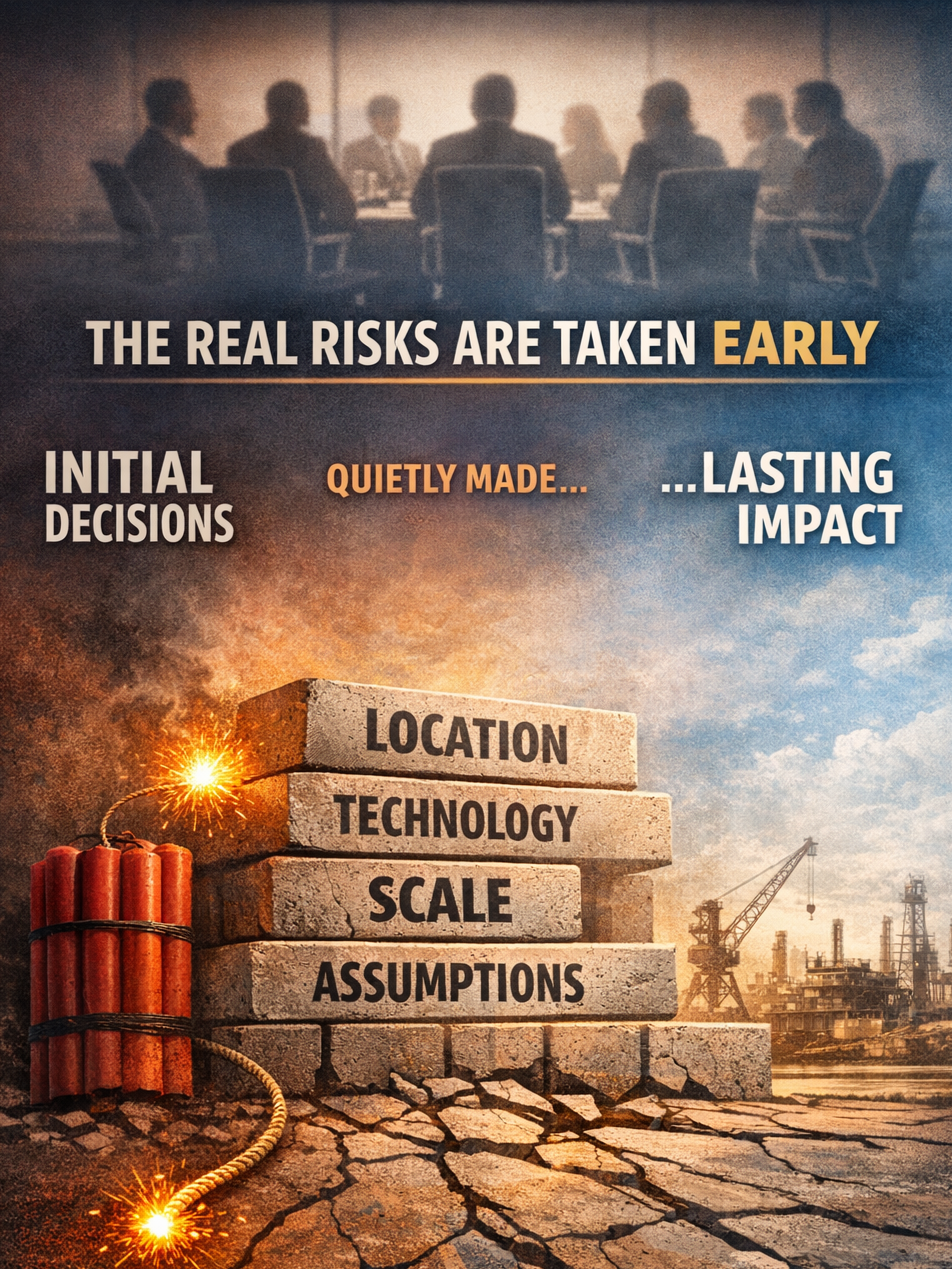
During project shaping and early front end loading, decisions are made that define the project’s economic envelope. Location. Scale. Technology path. Delivery model. Commercial assumptions. Once these decisions are accepted, even informally, they begin to close options. They narrow future choices. They harden assumptions that will later be defended as facts.
By the time a project reaches board approval, most of the value, risk profile, and capital exposure have already been determined. The board is not deciding whether to take risk. The board is deciding whether to fund risk that has already been taken.
Execution does not introduce this risk. Execution exposes it.
When projects struggle, organizations tend to look downstream for explanations. Construction productivity. Contractor performance. Supply chain disruption. Execution controls. These are visible and familiar. They feel actionable.
But execution teams do not invent constraints. They inherit them.
What execution reveals are the consequences of earlier decisions that were made before uncertainty was sufficiently reduced. A site that looked acceptable but was not fully vetted. A technology choice made before operating risks were understood. A scope definition locked before alternatives were fully evaluated. A schedule shaped around optimism rather than evidence.
None of these decisions are reckless in isolation. Taken together, they create what can be described as commitment risk.
Execution risk is manageable. It is measurable. It can be monitored and mitigated. Commitment risk is different. It is created when options are closed before leadership knows enough to justify closing them. It accumulates silently during early phases, often without explicit recognition by senior leadership or the board.
By the time formal approval is requested, changing direction is still possible, but it is no longer inexpensive. Capital, credibility, and time have already been committed.
This dynamic explains why predictability remains elusive despite decades of improvement in execution practices. Organizations continue to invest in better tools, better reporting, and tighter controls. Yet outcomes do not materially improve.
You cannot execute your way out of a poorly shaped investment.
Predictability is not created during construction. It is created when uncertainty is deliberately reduced early, when options are explicitly examined rather than implicitly closed, and when leadership insists on maturity before momentum.
This is where governance must function as a value protection system, not an approval formality. Governance is effective only when it improves decision quality. It must force clarity on what is known, what is assumed, and what remains uncertain. It must ensure that progress reflects learning, not just activity.
When governance allows projects to advance without resolving fundamental uncertainties, it does not accelerate value creation. It accelerates value erosion.
Ultimately, the strongest determinant of capital project outcomes is leadership behavior. Projects lose predictability not because teams lack tools, but because leaders disengage too early, tolerate unresolved uncertainty, or equate progress with advancement rather than readiness. Clarity must be reinforced continuously. Alignment must be maintained deliberately. If leadership messages are not repeated, they are not retained.
Capital value is rarely destroyed in a single decision or a single moment. It erodes incrementally through early choices that feel reasonable at the time and irreversible later. For capital constrained organizations, this erosion can be existential. Burned runway, weakened investor confidence, forced dilution, and loss of strategic options are not execution failures. They are the cumulative outcome of early decisions that were never treated as capital commitments.
The core message for boards is simple and consequential.
Execution does not destroy value.
It delivers exactly what was shaped upstream.
The biggest capital risks are taken before anyone thinks capital is at risk.
That is where governance, leadership attention, and fiduciary discipline matter most.

Cristian Gonzalez is CEO and Co-Founder of BPMP Solutions and host of Beyond the CapEx. With more than 20 years of experience across the full lifecycle of industrial capital projects, from concept development to commissioning, Cristian has worked inside projects that succeeded and those that struggled, giving him a clear perspective on what truly drives outcomes.
He focuses on the front-end stages where projects are shaped, structured, and positioned for long-term success. Cristian is known for bridging business strategy with technical execution, ensuring projects are aligned, risks are surfaced early, and leadership accountability is clear from day one.
Through Beyond the CapEx, Cristian explores the leadership, decision-making, and organizational dynamics that determine whether capital investments deliver real business value.
When Projects Fail, It’s Rarely Technical